Starship PR Enterprise: Captain’s log
When the Cannes Lions International Advertising Festival introduced a PR category to this year’s awards, who would have guessed that the inaugural accolade would go to an ad agency?
The PR Lions 16-strong jury, headed by Lord Tim Bell of Chime Communications, a man often referred to as ‘the third Saatchi’, awarded the prize for Best International PR Campaign to Australian advertising agency CumminsNitro for its ‘Best Job In The World’ strategy for Tourism Queensland.
Tourism Queensland wanted to launch a new brand, the Islands of the Great Barrier Reef, to global experience seekers across eight international markets.
The way in which CumminsNitro responded to that brief was breathtakingly simple.
They created ‘The Best Job in the World’—a genuine opportunity with Tourism Queensland where recruitment was driven via PR coverage, as well as online job sites and small display ads directing traffic to islandreefjob.com. The results were spectacular, the media coverage has been estimated at over $US100 million from a campaign budget of US$1.2 million.

The Kiwi Riviera
In New Zealand we have followed the trend acknowledged at Cannes. The recent establishment of a new CAANZ marcomms committee and the introduction of a new Effies category—Effective Use of PR/Experiential in a Marketing Campaign—are both timely and appropriate. That is because both these crucial components are part of the wider communications mix and are increasingly being used by marketers, adding value to the bottom line for brands and business.
The remit of the marcomms committee is simple. We exist to highlight and develop the value of PR and experiential services – something that we believe will benefit the industry enormously. We also believe there’s room for both the CAANZ marcomms committee and PRINZ, the more traditional organisational body dedicated to championing public relations and providing ongoing learning opportunities for consultants.
But let’s be clear.
This is not about different disciplines or different media channels. It’s about the potency of the idea and how it resonates with consumers, communities and stakeholders. It is also not about, as some in stand-alone PR consultancies might claim, making an unnecessary push for a conveniently ‘integrated’ ad solution.
It’s about acknowledging the power of creative concepts, driven through clever PR and experiential campaigns that spark substantial conversations and great outcomes.
Notable stunts
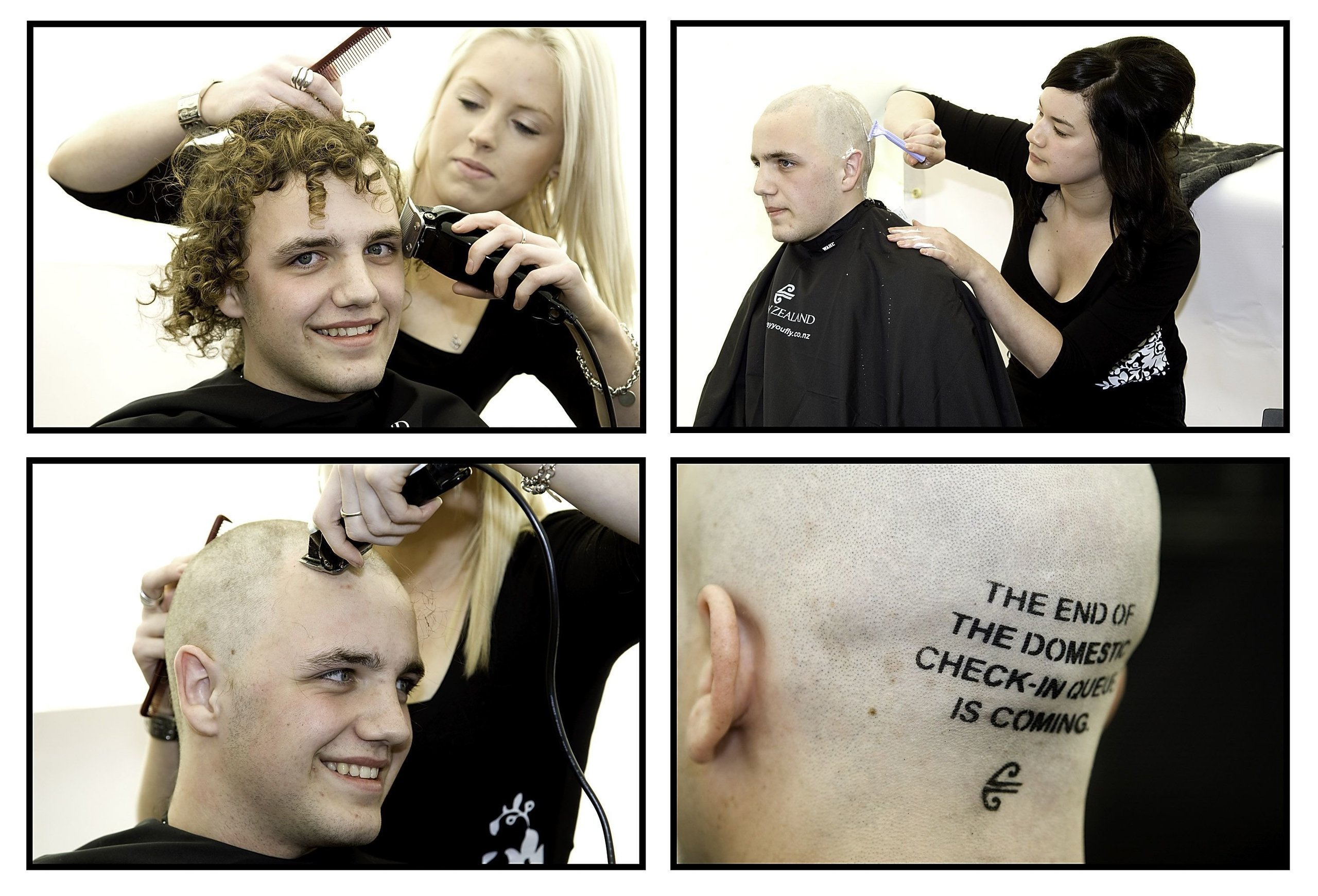
Air New Zealand’s ‘cranial billboard’ campaign by Mango is a great illustration of news-making PR. In September 2008 Air NZ offered $1000 for people to shave their heads and get a temporary tattoo emblazoned on the back announcing changes to Air NZ’s domestic check-in. They did the same thing a month later in California to promote international flights down under. Each cranial billboard was a walking advertisement for two weeks.

The Fresh ’n Fruity ‘Dunkathon’ initiative involving Hollywood stuntwoman Zoe Bell was executed by ELEVEN\PR as part of the Big Night In Telethon last month.


Taking Colenso BBDO’s overarching Fresh ‘n Fruity campaign concept of representing what happens when fruit and yoghurt collide, the stunt involved Bell dressed as a strawberry and jumping off the Sky Tower into a massive Fresh ‘n Fruity yoghurt pot. It resulted in nearly half a million dollars worth of media coverage on the back of a modest spend.
To boldly go
The committee will be looking at relevant professional development courses for marcomms agencies, clients and other CAANZ members, just as PRINZ does. What hasn’t been done yet by more traditional public relations practitioners, however, is fully acknowledge the changes taking place throughout the industry that have seen work like CumminsNitro’s ‘Best Job in the World’ campaign garner such critical acclaim.
The days of simply bashing out a well-worded release to the press, publishing a white paper or organising a press conference are long gone. There’s still a place for them, but if you want to reach and influence people, you’re going to have to engage more methods than these.
The members of the CAANZ marcomms committee acknowledge that there are entirely new fields of media and communication that brands should be a part of and more and that more companies are leaning heavily on PR spend.
The goal shared by chair Claudia Macdonald (Mango), myself and the other founding members is to celebrate the idea (no matter where it comes from) and highlight the importance of providing measurement, value and strong ROI along the way.


Kelly Bennett is deputy chair of the 


Vincent Heeringa
August 30, 2009
Can I make an early plug for a smarter media relations strategy?
As a media owner I’m sick to the teeth of clients employing PR agencies to send promotional stuff to journos and editors in exchange for ‘free’ copy. There’s nothing free about it. The PR agents are freeloading on the media that we have created, paid for and maintain through advertising and sales.
So long as PR is stealing marketing budget from other more useful forms there will, eventually, be no channels to freeload on.
As a policy we now refer all PR approaches to the sales team. Hopefully it’s scaring off the worst offenders. Even more hopefully it’s resulting in some advertising or other promotional activity for us.
PR industry listen up: if you want to get some ‘free’ coverage for your clients, stop thinking of yourselves and start thinking of the audience and the media owner. Ask yourself these questions: how can I help the media owner help me? Can I help grow circulation/audience/users by offering prizes and joint promos or by buying bulk susbcriptions? Can I help grow the channel by also supporting it through advertising (or suggesting that my clients do)? Can I provide useful relevant and well-researched content?
And can I stop annoying the journos with my trivial and ridiculous requests when they decide that my PR bumf is unpublishable?
That’s my plug. How about it Claudia and Kelly?
Claudia Macdonald
August 31, 2009
Good try Vincent – but I suspect you may be guilty of biting off the hand that feeds you.
The excellent new Marketing Magazine (great editor) ran a piece about trusted sources of information, based on Nielsen research. Guess what? People trusted word of mouth (personal recommendation) and newspaper editorial much more than they do advertising. What you are suggesting is that everything that appears in your publications is either paid for (ie advertising) or news that your journalists have discovered for themselves.
The trouble with advertising or paid editorial is that it is not as believable as that which has been through the steely eyes of a proper journalist. That is why companies employ PR people – to get their stories out there. Naturally it is up to us to ensure they are good stories and it is up to the journalists to judge them on their merit.
Secondly, in today’s resource-stretched media there are not enough journalists around to uncover all the news. Sometimes those PR people actually peddle quite interesting stuff.
And finally, the rationale behind PR linked to experiential is that we too realise that just writing stories is not enough, we need to touch people in a more engaging way. And with the exponential growth of social media, who knows, we may not need to rely on publishers for much longer….
Vincent Heeringa
August 31, 2009
The problem is exactly as you describe: resource-stretched media. Becasue so much freelaoding goes on, there’s less and less reason for clients to be paying for media to exist. The result is that fewer journalists wil be paid, fewer outlets will exist for professional writing and photographers and there will be both:
- an amateurisation of the industry
- a predominance of paid-for content.
I’m incredibly depressed about the future of the fourth estate as a business, since readers and advertisers increasingly want it all for free.
Where’s the business in that? There is none, so eventually there will be no credible channels to market for you.
I go back to my original question: how can you help me create a channel for you? I’d prefer it to be through advertising but, hey, if not that then what? I’m open to suggestion.
David MacGregor
September 1, 2009
Often companies and organisations actually have something useful to say about their products, businesses or causes – dare I say it – news…or the basis or news. The relationship between organisations and media was sybmbiotic and useful to audiences.
If the practice is now simply another way or describing attention getting (the valued commodity of the moment), then any infantile stunt will qualify. But the news will end up in the ‘weird’ section of the bulletin. Not every brand benefits from weirdness.
My measures of communications now are: Is it useful?; Is it interesting? Is it relevant? – no matter what the task or medium.
PR as party organising and creating stunt ‘events’ trivialises an important marketing communications discipline.
Jude Woodside
September 1, 2009
I agree wholeheartedly with Vincent on this as a media owner myself. We have a policy of not running freebie bumpf no matter what enticements accompany it.
One company in particular who have never run any advertising with us try on a monthly basis to feed us some PR waffle. Why do they suppose that we would carry their publicity material for free?
Contrary to Claudia’s assertion of the steely journalistic eye one piece in particular claimed a world first for this company…it was a little late given similar and superior products had been in the market for nearly a year by then, something which anyone associated with the industry would clearly know. Yet this piece was carried word for word in another magazine. (Sometimes I despair at the l lack of ethics in our industry.)
I also despair that brands are wasting enormous sums of money on these frivolities when they could be getting serious traction in advertising and maybe selling things.
We had an enormous box couriered to us from an Adelaide PR firm with a paintbrush inside: nice box, nice paintbrush, nice try.
I also agree with David our standards when assessing the value of a piece are similar: is it news, is it useful, interesting or relevant and …is it true?
Vincent Heeringa
September 1, 2009
Looking at the comments and then re-looking at the story, I think we must conclude there’s PR and then there’s PR. The Aussie tourism campaign and the AirNZ stunts were genuinely news worthy. They were clever and added value through humour and human interest.
Maybe David’s rule of thumb is the key for any comms, be it journalism or advertising?
That MacGregor, I’m sick of him being right.
Jason Kemp
September 1, 2009
I avoid television like the plague unless it is actually poking fun at the medium like the Daily show – but I can’t even remember that guys surname Jon someone so even that is a stretch.
That it is on at 10:30 pm at night and I still can’t find time to watch it might suggest there is plenty else going on that is far more compelling.
The TV news where that tourism story lived or on twitter became a steer around and instant unfollow offence.
Manipulation of media always looks like what it is.
I’m a contrarian so I’d expect to be an outlier on this stuff.
But really…
If PR agency got $100m of Pr from that stunt that just says the media must have hoped they would also benefit in a greater way but I’m not buying it.
I know many of the readers here have to suck up to PR agencies but come on there was nothing newsworthy about either “story” in my obviously biased opinion.
I don’t know a single person who even watched the telethon so its not just me – there are whole tribes who are increasingly avoiding “constructed” corporate scenarios like the ones mentioned above.
I don’t doubt that PR can help media leverage some of these ideas but I’d guess claimng $100m + for a spend of $1.2 is a very stupid way to present that particular story.
Nobody likes being taken for $98.8m suckers ride or do I have this wrong. :)
Vincent Heeringa
September 2, 2009
I disgaree, and you’re being overly precious, Jason. There’s newsworhtiness in a good marketing stunt or campaign, even if it’s just as a business story.
I mean, Jon Stewart makes a whole media show out of discussing media news. Talk about self referential.
If Claudia and Kelly can help lift the game overall, good luck to them. Make it compelling Kelly!
David Paine
September 3, 2009
Wow, good stuff. Love the forum and just have to throw in my two cents (or should that be $230 / hour) worth! Really lads and lasses, I think we are complicating a pretty simple thing here. As David says, it’s a symbiotic relationship so if you scratch my back I’ll scratch yours and we’ll all be happy. There is method in our rasping. LIke those in the music industry, publishers must find new ways of engaging their audiences and ensuring they pay for what they read. One thing Claudia’s dad used to hammer in to his apprentices – you, the PR consultant, and the media are on the same side. Our goals are intertwined – no PR wants to bore the reader; that is so counter-productive. And the closer publishers embrace their “enemy” the better it is for all concerned. For the life of me I have never been able to understand why most journalists don’t embrace their PR contacts and mine the hell out of them.
Gerry
September 4, 2009
I personally think most PR is a load of pants that makes little difference to people’s actual purchase decisions. Stunts that 5 people happen to see when passing by are even less impressive. I see a human strawberry crash into yoghurt from great heights or a tattoo on someone’s head…whoopee. Do I like the taste? The price? The packaging?
Bridgette Paton-Tapsell
September 7, 2009
Gerry, PR definitely does have the power to influence purchase decisions. A couple of recent examples from our agency Village PR (no $$$ stunt was involved here – just a plain old news release and media pitching).
We secured coverage for a Tauranga chef on Breakfast TV twice in three weeks and on the front page of his local paper promoting his avocado chocolates. Sales have gone up 1200 percent. Another client who runs a volunteer tourism company has had huge inquiry and bookings for her next trip (as well as a sizeable donation) as a result of an article in the NZH and Radio NZ interview.
Vincent – interested in your new policy of sending PRs to the sales room. I find SME clients who have had PR in magazines, are more inclined to consider these magazines when they advertise, particularly if perceive the editorial delivered a $ result. The role of PRs is also changing with the increase of boutique agencies. There are loads of businesses out there turning over a couple of million bucks with marketing budgets of around $20-$50k. Guess who they go to when booking an ad…their PR agent (we send them to a media buyer…). I’m with David Paine on this one.
Vincent Heeringa
September 7, 2009
Bridgette, so-long no-see! Regarding your question, we find that a minority will go ahead and spend some money on advertisin or work with us on a mutually beneficial joint promo.
A minority will feign offence: ‘you mean you want me to pay for reaching your customers with my breakthrough Baby Wear/Natural Cosmetics/Boutique
Wine/Eco-bag/Fair trade Vegetable Foot Cream brand that’s just like a million others? But we’re special!’.
And then the majority say they have spent the bulk of their marketing budget on seeking PR advice.
So, one out of three is better than nothing I guess!
Bridgette Paton-Tapsell
September 7, 2009
Hey Vincent
I downshifted to Maketu for about 7 years, got bored and upshifted again. So, back in the game.
Great site – addictive reading.
Jason Kemp
September 7, 2009
There is definitely a place for PR its just that it works best when it is not so obviously a stunt.
I don’t mind being media selective in the slightest. Jon Stewart has guest on his show that more than make up for him.
Its a fine line he treads and the trade off is that guests always have a book to sell. Sometimes that book might be worth a read but mostly we can get it i the 10 mins on the show which saves everyone time.
So there is some value there but that stunt where half a million of media coverage goes on the fresh and frooty thing. How bored must those media people be.
I’m sorry – I like yoghurt but a contrived piece of media manipulation is still not news by any stretch of the imagination.
And somewhere the PR company is watching this comment and asking did they spell freeeze and frooty correctly so why give them the satisfaction.
There hoisted by my own petard. Must go no – off to watch Jon whatisface’s guests on the daily show. :)
tinineunk
December 27, 2010
Hey there , like many of us I have had so many different complaints about my computer . I have young ones and it seems that whenever they apply the home pc, it doesn't run any longer when I use it. This last time, my oldest was seeing some web page link about an amount of 16 year old heart throb. Now each and every time I start my computer system , it freezes on me. Well, I observed this hyperlink on <a href=http://www.freewindowsregistryrepair.net>free registry repair</a> and it especially helped me out a great deal. It is ultra light and to the point and now my computer doesn't freeze anymore .