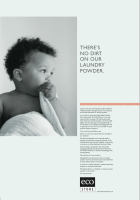
Washing powder keg explodes as ecostore takes Herald to task
It seems the print media’s dastardly scheme to get aggrieved companies to take out full page ads is working: after Air New Zealand responded to a Listener editorial with a cheeky video featuring Rob Fyfe, a dedicated website and a few full-pagers, ecostore has decided to follow suit, joining the reactionary party last weekend after an article in the Herald about washing powder ruffled its eco-feathers. In a story about misleading packaging claims regarding the PH levels of All Natural washing powder was a paragraph about ecostore laundry powder that said it had a pH of 11.8 according to Consumer NZ tests and that “it was a hazard under ERMA rules and needed child-proof packaging”. It also said that the company had reformulated its powder to meet national standards.
Ecostore’s marketing manager Melissa Fletcher says the gang was “quite dismayed” about the claims and the fact that the Herald ran it without talking to ecostore. So, having stood firm on its eco-credentials for over 18 years, it decided to act quickly with the help of its agency Special Group and its PR agency Wright communications by making a stand and trying to set the record straight.
“We wanted to nip it in the bud and the only way to do that was to go big and take out a full page ad.”
She admits it’s a slightly perverse dance when the Herald can run what she claims is a misleading article and then get $30,000 plus from an aggrieved party that wants to respond. But Ecostore felt so strongly about it and stands by its products 100 percent so it needed to splurge and act fast to get the point across that it doesn’t use petrochemicals or cheap bulking agents, and that it only uses all natural ingredients.
Originally, a story about All Natural appeared in Consumer magazine in May (it appeared in the Sunday Star Times soon after, so it’s also old news) and the ecostore folks were also alerted to a discrepancy in its PH labelling. Obviously, as it trades on its reputation, its honesty and its integrity, Fletcher says the company remedied the oversight independently as soon as it found out about it.
“That was an honest mistake. We were using a PH number that was fractionally incorrect [laundry powders in New Zealand are supposed to have a pH of 11.5 and ecostore's was 11.8], she says. But that’s only part of the story: when it comes to washing powders, she says it’s about total alkalinity. And that is kept low by using good quality, natural and more expensive ingredients.
Fletcher says ecostore does feel repercussions from other greenwashing companies, as consumers, some of whom may have been burned before, are often quite cynical when it comes green claims. For example, terms like biodegradable, she says, are quite vague. Technically nuclear waste is biodegradable if you wait millions of years. So who can you believe? Well, given ecostore has been in this game for such a long time, Fletcher thinks it should be asked when there’s a need to weed the truth from the porkies.






Deborah Pead
July 13, 2010
If Eco store were genuinely sorry when they were exposed by the Consumer magazine they would have used the full page ad to apologise for having sold stock 3X the legal limit of alkalinity (not fractionally higher). They would also acknowledged they distributed their products in packaging that wasn't childproof and contained no warnings. They would also have recalled the hazardous stock.
As PR practioners we have a responsobility to ensure clients act in the best interest of the consumer as well as themsleves. We are not here to whitewash – or in this case, greenwash the facts.
Pam Knox
July 13, 2010
Isn’t this the same ‘honest’ mistake they made with their dishwash powder a few years back, when kids ended up in intensive care? High pH was the problem then, as it is now. How about an honest apology?
Anonymouse
July 14, 2010
Aren't PR practitioners supposed to get their spelling and grammar right? ;-)
Malcolm Rands
July 14, 2010
Deborah Pead’s post is factually inaccurate. There is a big difference between pH and alkalinity when determining hazardousness. The fact is alkalinity determines whether a product is hazardous or not, not pH. The lower the alkalinity, the safer it is. Our laundry powder is not three times the legal limit of alkalinity in fact it has been independently proven to have the lowest level of alkalinity in Australasia (Lanfax laboratories 2009 – http://www.lanfaxlabs.com.au/alkalinity.htm). We believe there is no safer or healthier product on the market. Using pH levels to assess hazardousness is misleading. By this same account, some leading baby bar soaps on the market, which have a ph > 12, would be hazardous. This is clearly not the case. If you want to have the full facts, please refer to our website http://www.ecostore.co.nz .
Malcolm Rands
July 14, 2010
In answer to your question, Pam, ecostore has never been linked to anyone being admitted to intensive care or any other serious incident – this is categorically incorrect. We believer there are no safer or healthier products on the market. If you’d like to know more about pH levels, please refer to our website http://www.ecostore.co.nz.
Deborah Pead
July 15, 2010
I have checked the facts and stand by my comment.
Local legislation on this matter defines skin corrosiveness in terms of pH. The eco store acknowledges its powder had a pH of 11.8 The legal limit for products without hazard warnings and childproof packaging is 11.5. pH is measured on a logarithm scale and it is misleading to explain the pH level as ‘fractionally’ over the legal limit. The difference is as significant as a couple of points on the Richter scale. There is exponential power in those decimal points.
As a consumer of green products, I’m concerned the eco store – “integrity is everything to us” and with 18 years’ experience in the category – managed to get the basic science wrong. If school kids can test pH with litmus paper, how did eco store get it wrong and why did it take Consumer magazine to bring it to public attention?
Memo to those Ribena kids….
KW
July 15, 2010
"There is a big difference between pH and alkalinity when determining hazardousness. The fact is alkalinity determines whether a product is hazardous or not, not pH. The lower the alkalinity, the safer it is. "
pH is measure of acidity/alkalinity.
High pH = very alkaline.
pH of 7 = neutral (neither acidic nor alkaline)
Low pH = very acidic.
By your logic (the lower the pH the better) – a strong acid would be the ideal.
Malcolm Rands
July 15, 2010
Great to get this cleared up as it is technical.
pH is an indicator of how alkaline or acidic a substance is, as you rightly point out. All laundry powders are alkaline, with pH >10.
Total Alkalinity (or buffering capacity) is the true measure of how hazardous an alkaline substance is. This assesses how rapidly a substance alters it’s pH on contact.
pH can be misleading when assessing hazardousness. You can have two laundry powders with the same pH, but with very different alkalinity. The one with a high Total Alkalinity (buffering capacity) would be more hazardous than the one with a low Total Alkalinity.
That’s why leading baby soaps can have a pH > 12 but have low total alkalinity, making them safe to use on your baby.
And that is why we consider our laundry powder the safest on the market, as independent tests have shown our laundry powder has the lowest Total Alkalinity of all laundry powders in Australasia.
This means that the pH level of the waste water when using our laundry powder rapidly adjusts itself to align with its new soil environment, thereby not unbalancing the pH level of the soil from its optimal level. Making it safer to re-use on your gardens and lawns.
Please check out our website for more http://www.ecostore.co.nz
Rep
July 15, 2010
Soap powders are generally alkaline ie a pH exceeding 7. If the pH is near 7 then they are probably going to be ineffective.
Before everyone runs off about fractional differences and ERMA… The NZ Hazardous Substances (Minimum Degrees of Hazard) Regulations 2001 defines that:
(1) A substance with corrosive properties is not hazardous for the purposes of the Act unless—
…
(b) data for the substance indicates that the substance has a pH level of 2
or less, or 11.5 or more; or
(c) data for the substance indicates destruction of dermal tissue, being
visible necrosis through the epidermis and into the dermis, as a result
of exposure to the substance, that has not fully reversed within an
observation period of 14 days.
Therefore a washing powder with a pH > 11.5 is considered to be a corrosive substance that is hazardous under NZ regulations. A washing powder with a pH < 11.5 could ALSO be hazardous if it caused visible necrosis that doesn't heal in 2 weeks.
I guess a substance is either considered hazardous or it isn't…
Vincent Heeringa
July 15, 2010
Deborah: who is your client in this space? Can you declare your interest please? I suspect you are being paid by a competitor of ecostore – right?
skin
July 15, 2010
Surely its pretty straightforward as "Rep" says. If the pH is over the limit it shouldn't be on the shelves. That's great that it neutralizes quickly in water but it doesn't eliminate the hazard of the product in the box.
Malcolm – which baby soaps have a pH of 12?! I sure wouldn't be using them! I know Dove is around 7.
Westbrom for Premiership
July 15, 2010
What a load of old tosh … no, suds. I quote from the story: "But that’s only part of the story: when it comes to washing powders, she says it’s about total alkalinity." Total nonsense. What is the ph scale if not a measure of how alkaline or acid something is. Typical marketing drivel. Oh, and how nasty of the NZ Harold not to get Eco Store to check the story before it went to print. (I used to get that seemingly innocent but duplicitous request all the time from PR and marketing flunkies when I was an IT hack.)
TH
July 15, 2010
Sorry, – but no one has an automatic right to be heard when facts are related to the public. If I had produced a product that is proven to be hazardous to keep around children (and not warned about it) I obviously would want to respond, but it can hardly be the responsibility of a journalist to seek that response, if the purpose of the article is to act as a watchdog for the consumer. ( I believe this is the mission of Consumer) No matter what Eco Store could want to respond it will not remove the fact that regulations were not upheld and the product is harzardous. So I think this article starts off on the wrong foot. Surely Eco Store is distraught to be caught in the act, but it can hardly fall back on Consumer and The Herald.
Ronald
July 15, 2010
The packet shows kids on the front and says “skin friendly”?
I also remember the dishwash powder thing a few years ago where ecostore were named – same mistake twice eh?
Spend your marketing $$$ on a full page apology…
Deborah Pead
July 16, 2010
Vincent, as a PR trout who never misses an opportunity to promote a client, if I represented a brand in this space, you’d probably know about it. I can confirm that pead pr is not being paid by a competitor of ecostore and we don’t have a client in this space. But in the interest of full disclosure, I was part of the team that launched B_E_E in 2003, I have copy of Wendyl Nissen’s book ‘ domestic goddess on a budget’ and I’m trying hard to be a green goddess.
Green Green Greg
July 16, 2010
Jeez – if the stuff was over the PH limit and illegal – great they fixed it -but, what about all the stock out in the market that still had the illegal/dangerous PH level? Don't the grocery chains (FoodStuffs & Progressives)have an obligation in this whole thing? If they were alerted, the product should have been pulled based on public safety. Not like the Vitamin C levels were too low or something like that…